
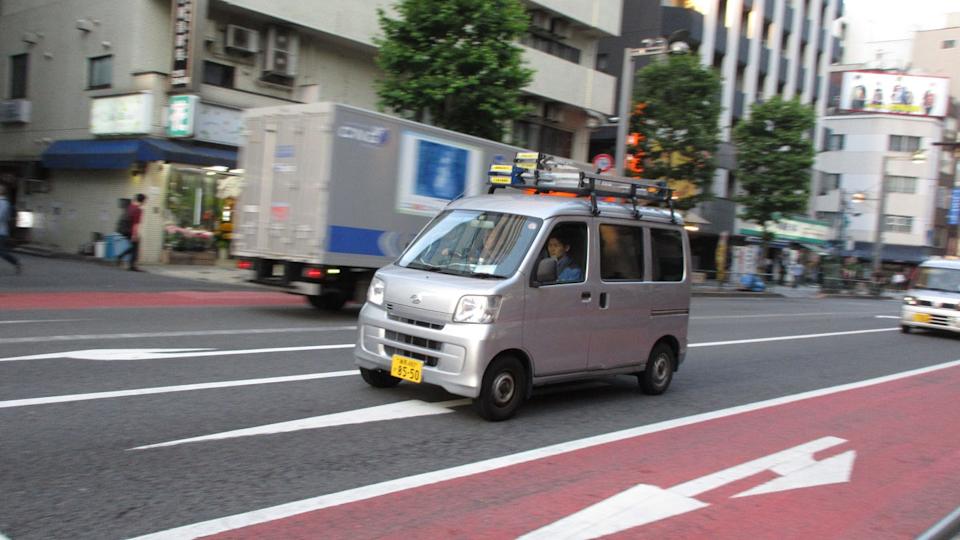
In the throbbing arteries of megacities like Tokyo, where skyscrapers crowd out the sky and traffic crawls through labyrinthine alleys, a quiet revolution rolls on four tiny wheels. Meet the Keibann—Japan’s legendary kei vans, also known as keiban. These micro-vans, no longer than a compact sedan yet bursting with clever engineering, have become the unsung heroes of urban logistics. Born from post-war necessity and refined for modern chaos, Keibann vans thrive where full-sized vehicles falter. Their compact footprints, razor-sharp maneuverability, and surprising cargo capacity make them ideal for deliveries, trades, and daily hustles in space-starved cities. From narrow side streets to premium parking hunts, these pint-sized powerhouses deliver efficiency, economy, and eco-friendliness in one nimble package. This article dives deep into why Keibann vans aren’t just cute—they’re essential tools for thriving in busy urban jungles.
The Birth of Keibann: Japan’s Post-War Answer to Urban Density
Keibann vans trace their roots to 1949, when Japan introduced the “kei” (light) vehicle category to rebuild a war-torn economy. The government needed affordable, fuel-sipping machines to mechanize transport without straining resources. Early models like the Daihatsu Hijet (introduced in 1960 as both truck and van) set the template: strict limits on size and power in exchange for tax breaks and insurance perks. Over decades, regulations evolved—engines grew from 360cc to the current 660cc cap, dimensions stretched to 3.4 meters long, 1.48 meters wide, and 2 meters tall—but the core philosophy remained: maximum utility in minimal space.
Today, Keibann dominate Japan’s commercial fleet. In crowded Tokyo, where public transit rules but last-mile delivery demands flexibility, these vans handle everything from flower shop runs to construction hauls. Their design prioritizes cab-over layouts (engine under or behind the cabin) to maximize cargo room. Modern variants even include electric options, like Toyota’s Pixis Van BEV with a 257 km range and cavernous loading space. This heritage of smart adaptation explains their enduring appeal in any bustling city facing similar constraints.
Compact Design: Built for the Tightest Streets
What sets Keibann apart is their engineering precision. At under 11.2 feet long and 4.9 feet wide, they slip through gaps that swallow larger vans. A tight turning radius—often under 4 meters—lets drivers U-turn in alleys barely wider than the vehicle itself. High-roof designs (up to 6.6 feet tall) create boxy interiors without sacrificing exterior compactness, while tall seating positions offer commanding visibility over traffic.
Popular models like the Suzuki Every, Daihatsu Hijet Cargo, Honda Acty, and Nissan NV100 Clipper exemplify this. The Hijet, for instance, packs a surprisingly robust payload of 600-1,300 pounds despite weighing around 1,800 pounds empty. Four-wheel-drive options tackle light off-road or snowy urban deliveries. Unlike bulky American pickups or European panel vans, Keibann prioritize simplicity: basic mechanics mean fewer breakdowns in stop-start city traffic. This design isn’t a compromise—it’s optimization for environments where every inch counts.
Effortless Maneuverability in Congested Traffic
Busy cities punish large vehicles with endless bottlenecks. Keibann vans flip the script. Their lightweight construction (often under 1,000 kg) and peppy 63-horsepower engines deliver agile acceleration ideal for weaving through gridlock. Drivers report zipping past delivery trucks stuck in jams, slicing through markets, and accessing pedestrian-only zones where bigger rigs can’t venture.
In Tokyo’s historic districts or Karachi-like sprawls in emerging markets, these vans excel at “last-mile” work—think courier services, mobile repair shops, or food delivery fleets. Real-world examples abound: Brooklyn landscapers now import them for tight job sites, praising how they navigate where Ford F-150s fail. Fuel efficiency shines here too, with many models hitting 35-60 mpg in city driving, slashing operating costs by half compared to conventional vans. The result? Faster turnarounds, happier drivers, and lower emissions per delivery.
Parking Mastery: Fitting Where Others Can’t
Parking in metropolises is a nightmare—Tokyo’s average spot is half the size of an American one. Keibann vans turn this into an advantage. Their diminutive length allows parallel parking in gaps too small for sedans, and their height lets them tuck into multi-level garages or under low overhangs. Owners stack four in a standard two-car space, a feat impossible for full-size vans.
In practice, this means no circling blocks or paying premium lots. Tradespeople park curbside for quick jobs; delivery drivers load and unload without double-parking fines. Japanese kei regulations even incentivize this with lower taxes, encouraging widespread adoption. As cities densify globally—from Faisalabad’s narrow lanes to New York’s boroughs—Keibann-style solutions reduce congestion by freeing road space. One U.S. importer noted: “You shoehorn these into spots that seem impossible, and visibility is excellent thanks to those huge windows.”
Cargo Versatility: Small Outside, Massive Inside
Don’t let the size fool you—Keibann vans are cargo beasts. Cab-over engineering yields flat, expansive load floors. The Daihatsu Hijet Cargo offers up to 6 feet 3 inches of internal depth, 4 feet 7 inches wide, and 4 feet 1 inch tall, with sliding doors and low floor heights (around 24-25 inches) for easy loading. Payloads rival mid-size trucks, while fold-flat seats convert them into mobile workshops or even mini campers.
Business users love the modularity: roof racks for ladders, custom shelving for tools, or refrigerated units for perishables. In Japan, wheelchair-accessible variants aid aging populations. Electric models like the new Toyota BEV maintain this space while adding zero-emission cruising. Compared to a standard van twice the length, Keibann deliver comparable utility at a fraction of the footprint—proving that clever packaging beats brute size every time.
Economic and Environmental Wins for Urban Operators
Keibann vans aren’t just practical—they’re profitable. In Japan, kei classification brings rock-bottom taxes, insurance, and registration fees. Fuel costs plummet with 40-80 mpg ratings (some hybrids push higher), and maintenance is cheap thanks to widespread parts availability. A used model might run $1,000-$5,000, making them accessible for small businesses.
Environmentally, their tiny engines and light weight cut CO2 output dramatically—perfect for cities battling pollution. New BEV versions extend this to zero tailpipe emissions. Globally, imports are booming in the U.S. and Europe for eco-conscious fleets. In busy Asian cities, they reduce traffic density by replacing multiple larger vehicles with one efficient runner. The bottom line: lower overheads, greener operations, and compliance with tightening urban emission zones.
Global Ripple Effect: Keibann Beyond Japan
While born in Japan, Keibann vans are conquering new territories. U.S. enthusiasts import pre-1999 models legally, using them on farms, in cities, and for off-road fun. European markets appreciate their efficiency amid rising fuel prices. Even in Pakistan’s bustling hubs like Faisalabad, their principles inspire local micro-vans tailored to narrow bazaars and dense neighborhoods.
Innovations keep pace: 2025 models feature advanced safety (automatic braking), infotainment, and hybrid powertrains. Brands like Honda (N-Box, Japan’s bestseller) and Mitsubishi (Delica Mini) blend utility with modern styling. As urbanization accelerates—projected to house 68% of the world’s population by 2050—Keibann blueprints offer a scalable model for sustainable transport.
Why Keibann Represent the Smart Future of City Mobility
Keibann vans prove that bigger isn’t always better. In busy cities plagued by congestion, pollution, and parking shortages, their tiny stature delivers outsized benefits: unmatched agility, wallet-friendly operation, versatile hauling, and lighter environmental footprints. From Tokyo’s alleys to global urban cores, they embody efficient, human-scale design in an era of oversized vehicles.
As cities evolve, adopting Keibann logic—whether through imports, local adaptations, or inspired micro-mobility—could ease gridlock and foster greener growth. These aren’t just vans; they’re rolling testaments to ingenuity under constraint. If your city feels too crowded for comfort, perhaps it’s time to think small. The Keibann way might just be the big solution we’ve been overlooking.